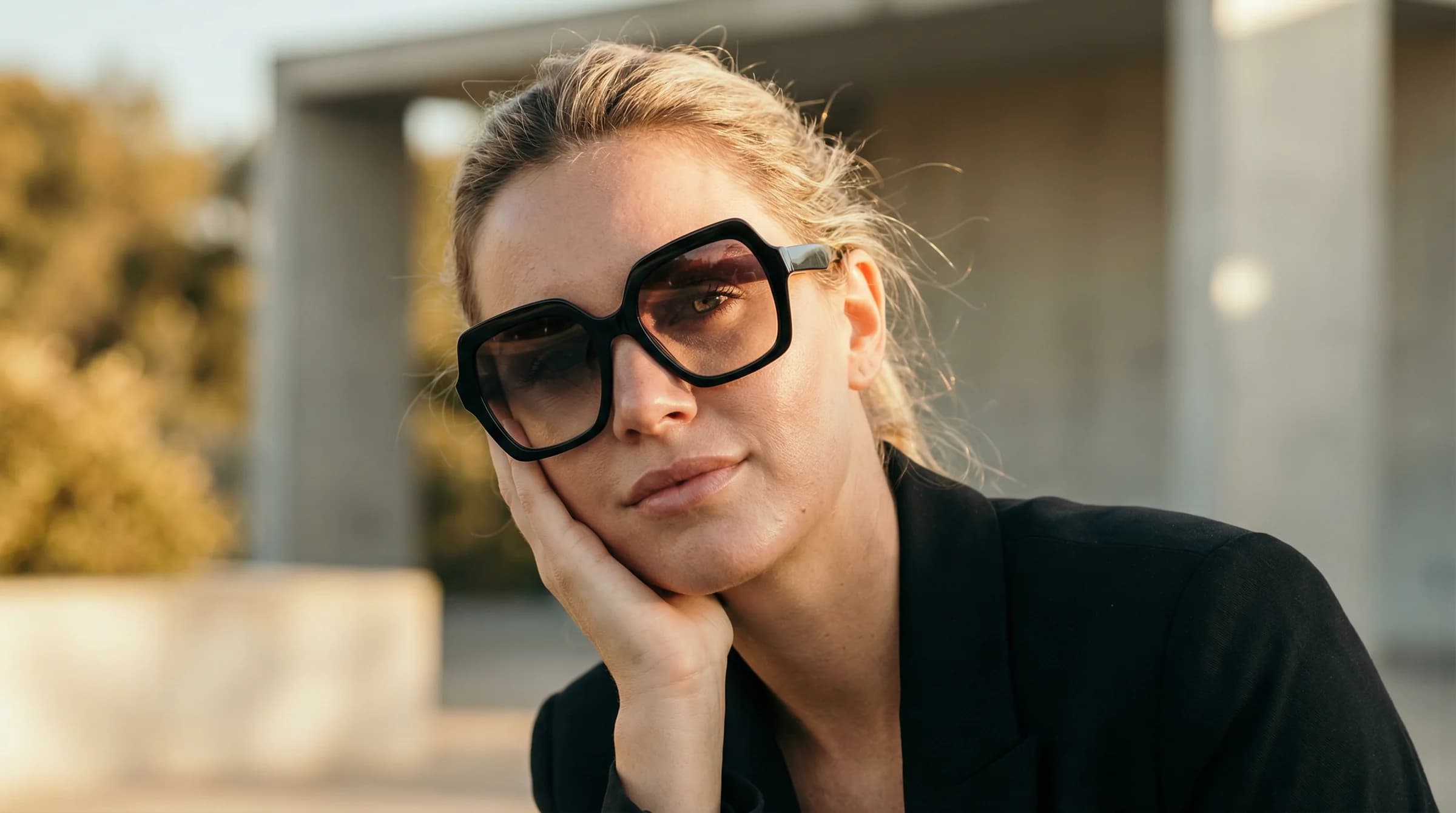
Choosing Sunglasses for Golf: The Right Lens for the Courses of Belek
Choosing golf sunglasses comes down to lens colour, filter category, polarisation and how the frame fits. A simple guide for the golf courses of Belek.
Published: 8 min readGoldeneye Optik
Short answer
For golf, a sunglass lens with UV400 protection, a category 2 or 3 tint and a brown, amber, copper or rose shade is suitable; these shades increase contrast and make it easier to pick out the ball and the slope of the ground. Polarisation is a personal preference. The frame should be light, wrap around the face, stay put on the nose and not cut into your field of view in the address position.
Key points
- The first feature to look for in golf sunglasses is UV400 protection, because a round of golf lasts for hours and is spent outdoors.
- Brown, amber, copper and rose lenses increase contrast and make it easier to pick out the ball and the slope of the ground.
- Category 2 and category 3 lenses suit the golf course; category 2 is used in changing light and category 3 in strong sun.
- Polarised lenses are a personal preference in golf, because some players feel they affect reading the slope on the green and depth perception.
- The frame of golf glasses should be light, wrap around the face, not slide down the nose and not cut into your field of view in the address position.
When choosing golf sunglasses, three things matter: the UV protection of the lens, its colour and tint, and whether the frame stays in place during the swing. Belek is known as the golf centre of Türkiye, the area has many golf courses and a round lasts for hours outdoors. So the glasses you wear on the course are chosen by slightly different criteria from the glasses you wear in town.
What features should golf sunglasses have?
Golf sunglasses should have a lens with UV400 protection and a category 2 or 3 tint, and a light frame that wraps around the face and does not slide down the nose. For lens colour, contrast-enhancing brown, amber, copper and rose shades stand out. Polarisation, on the other hand, is not a must but a matter of the player's own preference.
The table below sums up the features to check on golf glasses and the reasons for them.
| Feature | Suitable choice for golf | Why |
|---|---|---|
| UV protection | UV400 label and CE mark | A round of golf lasts for hours and is spent outdoors |
| Filter category | Category 2 or category 3 | Gives enough tint in moderate and strong sun |
| Lens colour | Brown, amber, copper, rose | Increases contrast, so the ball and the slope are easier to pick out |
| Polarisation | Personal preference | Filters glare, but some players feel it affects reading the slope |
| Lens material | Polycarbonate | Light and impact-resistant |
| Frame | Light, wraps around the face, non-slip nose pads | Stays in place during the swing and does not cut into your view |
Why does UV protection come first in golf?
UV protection comes first in golf because a round lasts for hours, and all of that time is spent outdoors, often in areas without shade. The UV400 label means the lens does not let through ultraviolet light up to 400 nanometres, which covers almost all UVA and UVB. In Türkiye and the European Union, non-prescription sunglasses count as personal protective equipment and carry the CE mark.
On the course, light does not only come from above. Bunkers and water surfaces reflect light, so a cap or visor does not replace sunglasses; the two are used together. The UV protection of a pair of glasses can be checked with a device that measures UV transmission. What to look for on the label is explained in detail in our article what does UV400 mean.
Which lens colour suits golf?
Brown, amber, copper and rose lenses suit golf because these shades increase contrast and make it easier to pick out the ball and the slope of the ground. Contrast helps in two places in golf: when following the ball in the air or on the grass, and on the green, the closely mown area around the hole, when reading which way the ground slopes.
| Lens colour | Effect on the image | Use in golf |
|---|---|---|
| Brown | Increases contrast | Preferred in changing light |
| Amber and copper | Increase contrast | Make it easier to pick out the ball and the slope of the ground |
| Rose | Increases contrast | Sharpens the distinction between the ball and the grass |
| Grey | Reduces light without changing colours | Suits players who want to see natural colours |
| Green (G-15 tone) | Balances contrast and natural colour | Suits players who want both qualities |
| Yellow | Gives contrast in low light | Not suitable for strong sun |
A mirror coating reflects part of the light reaching the lens and can be combined with different lens colours. Lens colour does not determine UV protection; whichever colour you choose, check for the UV400 label separately. For how the colours differ in everyday use, see our article on sunglass lens colours.
Which filter category is used on the golf course?
Category 2 and category 3 lenses are used on the golf course. The filter category shows how much visible light a lens lets through, with numbers from 0 to 4; the higher the number, the darker the lens.
| Category | Visible light transmission | When it suits the course |
|---|---|---|
| Category 2 | 18-43%, medium tint | Moderate sun; rounds played early in the morning or towards evening, partly cloudy weather |
| Category 3 | 8-18%, dark | Strong sun; rounds that fall in the middle of the day in Antalya |
| Category 4 | 3-8%, very dark | Meant for extremely bright places such as high mountains and glaciers; not suitable for driving |
On most sunglasses the category number is printed on the inside of the temple, next to the CE mark. The category describes the tint, not the UV protection, so the two are checked separately. You can find all five categories in our article on sunglass filter categories.
Should golfers choose polarised lenses?
Polarised lenses are a personal preference in golf; there is no single answer that applies to every player. A polarised lens filters the glare reflected off flat surfaces such as water and wet ground. Because it reduces glare around water hazards, some players find it comfortable to play with polarised lenses.
On the other hand, some players feel that polarised lenses affect reading the slope on the green and depth perception. In addition, some LCD screens, such as phones, can look dark or tinted at certain angles through a polarised lens. So before deciding, it helps to try the lens outdoors, looking at a grass surface.
Polarisation and UV protection are separate features; having one does not mean you have the other. To find out whether a lens is polarised, look at an LCD screen through the glasses and turn them 90 degrees: if the screen goes dark, the lens is polarised. How the lens works is explained in our article what are polarised sunglasses.
What kind of frame suits golf?
A frame for golf should be light, wrap around the face, have non-slip nose pads and not cut into your field of view during the swing. In the address position your head tilts forward and your eyes look down at the ball. A thick lower rim or a small lens can fall right in that line of sight, so golfers prefer frames with wide lenses and a thin or open lower rim.
A frame that wraps around the face reduces the light coming in from the sides. Non-slip nose pads and temple tips help the glasses stay in place when you sweat and when you tilt your head. As a lens material, polycarbonate is common in sports glasses because it is light and impact-resistant; mineral glass resists scratches but is heavy and can break.
Before you buy, you can try the glasses with these steps:
- Put the glasses on and tilt your head forward as in the address position. The glasses should not slide down your nose.
- Keep your head still and lower your eyes to where the ball would sit. The lower rim of the frame should not get in the way of your view.
- Turn your shoulders and head as if swinging. The temples should hold without pinching and the glasses should not move.
- If you wear a cap or visor, try the glasses with it. The frame should not touch the peak.
- If possible, step out into daylight and look at the grass and the sky. Lens colour and tint are judged in real light.
- Check for the CE mark and the category number on the inside of the temple, and for UV400 on the label.
What can golfers who wear prescription glasses do?
Golfers who wear prescription glasses have options such as prescription sunglass lenses and clip-ons that fit some frames. A prescription lens is a medical device and is supplied only against a prescription written by an ophthalmologist. An optician does not examine the eyes or determine your prescription; if your prescription is not up to date, you see an ophthalmologist first.
The criteria in this article for UV protection, filter category and lens colour apply to prescription sunglass lenses as well. Lenses cannot be fitted to strongly curved wraparound frames for every prescription; ask the optician about this when choosing the frame.
What should you check before heading out on a course in Belek?
Before heading out on a course in Belek, check the UV label of your glasses, the lens category and how you will look after them after the round. In the Antalya sun, sweat and sunscreen get onto the lenses and nose pads during a round. When the round is over, rinse the glasses with fresh water and dry them with a clean microfibre cloth; do not wipe a dry lens, because dust on it scratches the lens. Carry the glasses in a hard case and do not leave them in the car in summer, as high temperatures can damage the coating and the frame.
For players who arrive on holiday without sunglasses, or whose glasses get damaged on the course, there are optician's stores in the area. Goldeneye Optik is an optician's establishment in Kadriye Mahallesi (Serik, Antalya), next to the Belek tourism area. The store is open Monday to Saturday 10:00-20:00 and Sunday 11:00-18:00, and the team serves customers in Turkish, English, Russian and German.
Frequently asked questions
Which lens colour is preferred for playing golf?
Brown, amber, copper and rose lenses are the usual choices for golf. These shades increase contrast, making it easier to pick out the ball against the grass and the sky and to read the slope of the ground. Grey lenses reduce light without changing colours and suit players who want natural colours. Lens colour does not determine UV protection; whichever colour you choose, look for UV400 on the label.
Are polarised sunglasses suitable for golf?
Polarised lenses are a personal preference in golf. Because they filter the glare reflected off water hazards and wet surfaces, some players find them comfortable. Other players feel that polarised lenses affect reading the slope on the green and depth perception. To decide, try the glasses outdoors if possible, looking at a grass surface. Polarisation does not mean UV protection; the two are separate features.
Which filter category should I choose for golf?
Category 2 and 3 lenses suit golf. Category 2 is a medium tint that is comfortable early in the morning, towards evening and in partly cloudy weather. Category 3 is a dark tint and is chosen in strong sun around midday. Category 4 is very dark, is meant only for extremely bright places such as high mountains and is not suitable for driving. On most sunglasses the category number is printed on the inside of the temple.
Do darker lenses protect the eyes more on the golf course?
No, the darkness of a lens does not show its UV protection. Darkness only reduces the visible light reaching the eye; the filter that blocks ultraviolet light is a separate feature and can even be colourless. A dark lens without a UV filter makes the pupil widen and can let more ultraviolet light into the eye. So with golf glasses, check the UV400 label and the CE mark first, then the tint and the colour.
Can people who wear prescription glasses wear sunglasses for golf?
Yes, there are options for people who wear prescription glasses, such as prescription sunglass lenses and clip-ons that fit some frames. A prescription lens is a medical device and is supplied only against a prescription written by an ophthalmologist; an optician does not examine the eyes or determine your prescription. For prescription sunglass lenses, UV protection, filter category and lens colour are judged by the same criteria as for non-prescription glasses. If your prescription is out of date, see an ophthalmologist first.
If I wear a golf cap, do I still need sunglasses?
A cap or visor alone is not considered enough. A peak blocks the light coming from above, but light reflected off the grass, sand and water reaches the eye from below and from the sides. That is why on the golf course a cap and sunglasses are used together, not instead of each other. When choosing glasses, it helps to check that the frame does not touch the peak or brim of your cap and does not move in the address position.
This article is for general information only and does not replace diagnosis or treatment. For any concern about your eyes, see an ophthalmologist.