Choosing Sunglasses for Children: What Should You Look For?
When choosing children's sunglasses, look for UV400 and the CE mark, a category 3 lens for the beach, impact-resistant polycarbonate and a snug, flexible frame.
Published: 9 min readGoldeneye Optik
Short answer
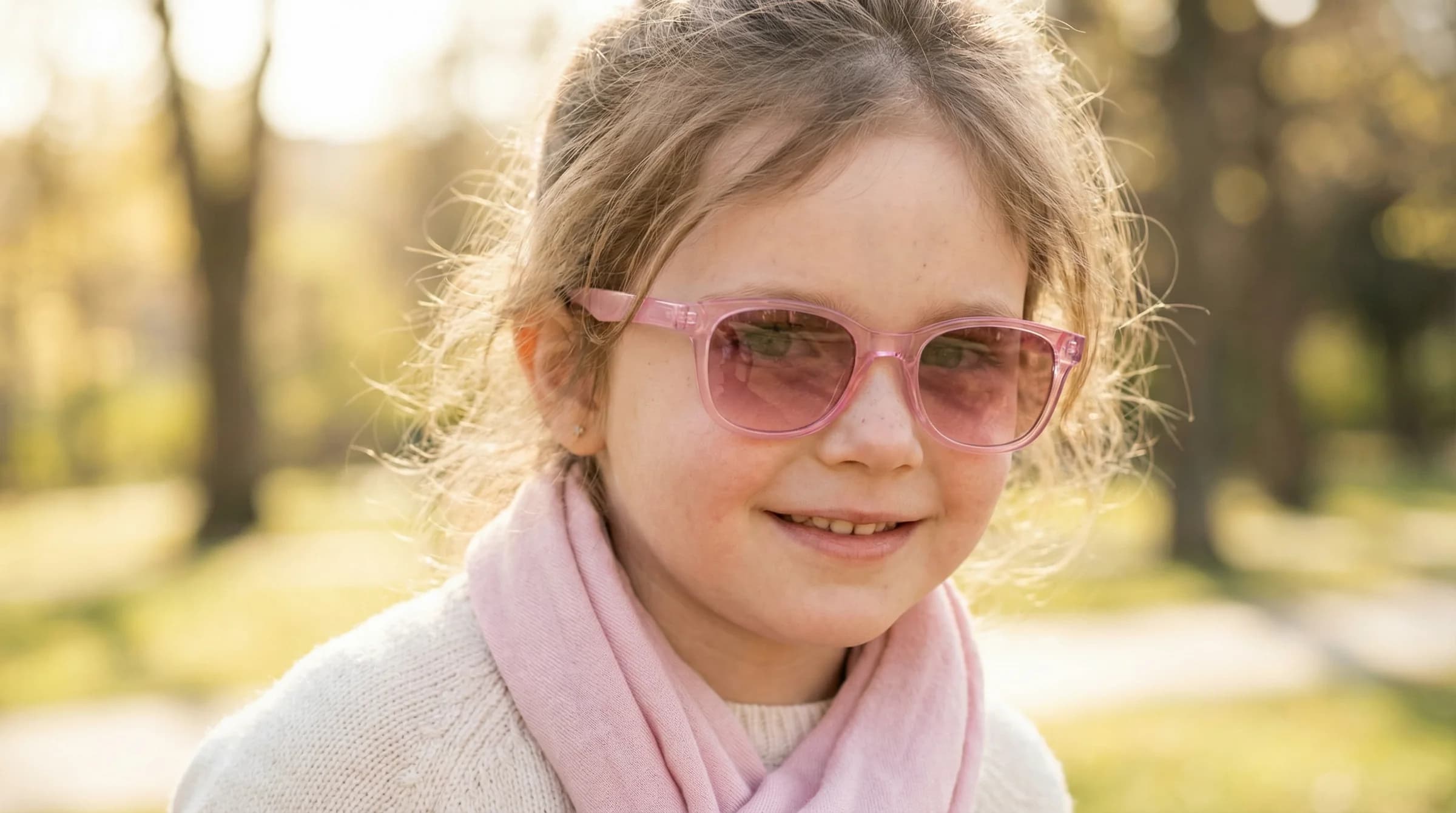
When choosing sunglasses for children, first check the UV400 label and the CE mark; the darkness or colour of a lens says nothing about UV protection. For the beach and the pool, look for a category 3 lens, impact-resistant polycarbonate and a flexible, snug frame. A strap helps on young children. Wear the glasses with a hat and shade, and let children choose the model themselves.
Key points
- A child's eye lens is clearer than an adult's and lets through more ultraviolet light, so UV protection is the first criterion for children's sunglasses.
- Look for the UV400 label and the CE mark on children's sunglasses; the darkness or colour of a lens does not show its UV protection.
- A category 3 lens suits places with strong sun, such as the beach, the pool and the seaside.
- Polycarbonate is light and impact-resistant, which makes it a suitable lens material for active children.
- Sunglasses alone are not enough; they are worn together with a peaked or wide-brimmed hat and shade.
When choosing sunglasses for a child, look at how well the lens filters ultraviolet (UV) light before you think about colour or style. Children's eyes are more exposed to ultraviolet light than adults' eyes, and children spend a lot of time outdoors. The right pair has the UV400 label and the CE mark, impact-resistant lenses and a frame that fits the face snugly.
Why should children wear sunglasses?
Children should wear sunglasses because a child's eye lens is clearer than an adult's and lets through more ultraviolet light. Add to this the long hours spent outdoors: the park, the school playground, the beach and the pool take up much of a child's day.
Ultraviolet radiation cannot be seen and is not felt as heat. UVA has a wavelength of 315-400 nanometres and UVB 280-315 nanometres, while UVC is absorbed by the atmosphere. Long, unprotected exposure to the sun is a risk factor for the eyes, and this exposure adds up over the years. In a region like Antalya, with long summers and strong sun, this is a topic for the whole year, not just for the holiday week.
What should you look for in children's sunglasses?
There are five things to look for in children's sunglasses: the UV400 label, the CE mark, the filter category, impact-resistant lenses and a flexible frame that fits the face. For young children, add a strap. The table below sums up each criterion in a single row.
| Criterion | What to look for | Why it matters |
|---|---|---|
| UV protection | UV400 label | The lens does not let through ultraviolet light up to 400 nanometres |
| Conformity mark | CE mark | Non-prescription sunglasses count as personal protective equipment |
| Filter category | Category 3 for the beach and the sea | Reduces dazzle in strong sun |
| Lens material | Polycarbonate | Light and impact-resistant |
| Frame | Flexible, fits the face, does not slip | The glasses stay in place during play |
| Strap | A strap around the back of the head for young children | Makes it harder for the glasses to fall off and get lost |
The UV400 label and the CE mark
The UV400 label means the lens does not let through ultraviolet light up to 400 nanometres, which covers almost all UVA and UVB. The European and international standard for sunglasses is EN ISO 12312-1; this standard takes 380 nanometres as the UV limit, while the UV400 label indicates protection beyond that, up to 400 nanometres. In Türkiye and the European Union, non-prescription sunglasses count as personal protective equipment and carry the CE mark.
The darkness of a lens does not show its UV protection. A UV filter can be colourless: a light lens can be UV400, while a very dark lens may have no UV filter at all. So the decision is made by reading the label, not by looking at the colour of the lens. The topic is explained in detail in our article what does UV400 mean.
Filter category: category 3 for the beach
A category 3 lens suits the beach, the pool and the seaside. The filter category shows how much visible light a lens lets through and is numbered from 0 to 4. Category 3 lenses let through 8-18% of visible light; they are used for strong sun, the beach, the sea and the mountains, and are the most common category. In moderate sunshine category 2 (18-43%) can also be used. Category 4 is very dark and is meant for extremely bright places such as high mountains and glaciers; it is not needed for everyday use.
On most sunglasses the category number is printed on the inside of the temple, next to the CE mark. The category describes how dark the lens is, not its UV protection, so the two are checked separately. All five categories are listed in a table in our article on sunglass filter categories.
Impact-resistant lenses: polycarbonate
Children's glasses need impact-resistant lenses, and the most common material with this property is polycarbonate. Polycarbonate is a light, impact-resistant lens material; for a child who plays ball, runs and falls over, both qualities matter together. Mineral glass, meaning real glass, is the most scratch-resistant material but it is heavy and can break, so it is not considered a practical choice for an active child's glasses.
A light lens also makes the glasses less likely to slide down the nose. A child will take off glasses that feel heavy after a few minutes and will not want to put them on again.
A flexible frame that fits the face
A child's frame should be flexible and fit the face. A flexible material copes better with bending and being sat on, and a frame that fits the face reduces the light coming in from above and from the sides. You can check the glasses on your child's face in this order:
- The width of the frame should be close to the width of the face; it should neither stick out past the temples nor squeeze them.
- The glasses should not slide down the nose when your child bends forward and shakes their head.
- The temples should not press behind the ears or leave marks.
- The lenses should cover the eyes up to the eyebrows, and the eyelashes should not touch the lens.
- When your child looks up, down and to the sides, their gaze should not catch on the edge of the frame.
Glasses bought a size too big so that they will still fit later slip, let light in from the sides and often end up not being worn. Choose the size that fits your child's face today.
What is a strap for on young children?
A strap keeps the glasses steady on a young child's head. Young children's nose bridge is not yet well defined, so glasses slip easily; an adjustable strap around the back of the head makes it harder for the glasses to fall off, hit the ground and get lost. On models with a strap, look for one that is soft, does not pull the hair and can be adjusted in length. As your child grows, you move from a strap to a frame with temples.
What is the difference between toy glasses and protective sunglasses?
Toy glasses are made for play and dressing up; protective sunglasses are made to filter ultraviolet light and say so on the label. The two can look alike from the outside, and the label shows the difference.
| Feature | Toy glasses | Protective sunglasses |
|---|---|---|
| Purpose | Play, dressing up, accessory | Protecting the eyes from sunlight |
| UV information | May be missing from the label | UV400 label |
| Category information | May be missing | A number from 0 to 4 on the inside of the temple |
| Lens | May only be tinted | UV-filtering, preferably impact-resistant |
If the label of a pair you already have is lost, or you are unsure about its protection, the UV protection of the lens can be checked in an optician's store with a device that measures UV transmission.
Do children need polarised lenses?
Polarised lenses are not essential for children, but they make time by the water more comfortable. A polarised lens filters glare reflected off flat surfaces such as water, reducing dazzling reflections at the seaside, by the pool and on a boat. Polarisation and UV protection are separate features, and one does not replace the other: on a polarised lens, the UV400 label is checked separately as well. The details are in our article what are polarised sunglasses.
Are sunglasses enough on their own?
No, sunglasses are not enough on their own; they are worn together with a hat and shade. Glasses filter the light coming from the front, while a peaked or wide-brimmed hat reduces the light coming from above and from the sides. Because water and light-coloured sand reflect sunlight, on the beach the light does not only come from the sky.
For a day on the beaches of Belek and Kadriye or by the pool, this routine works well:
- When your child goes outside, the glasses and the hat go on together.
- Around midday, when the sun is highest, choose the shade of a parasol or a tree.
- After the beach or the pool, rinse the glasses with fresh water; salt and sand can scratch the lens.
- Put the glasses in their case, not on the sand or between towels.
- Wear the glasses on cloudy days too; clouds do not block all ultraviolet light.
Other practical eyewear tips for the holiday are collected in our visitor's guide for Belek and Kadriye.
Why does it matter that children choose their own glasses?
It matters because children wear glasses they have chosen themselves more willingly, and sunglasses only work while they are being worn. The division of roles is simple: you set the protection criteria and your child chooses the colour and model. First set aside a few pairs with the UV400 label, the CE mark, impact-resistant lenses and a frame that fits their face, then leave the final decision to them.
A few more things make it easier to get used to them. If the glasses are light and do not pinch anywhere, your child will forget they are wearing them. If you wear sunglasses outdoors too, your child will see them as a normal part of the day. Starting with short periods in the first few days and building up works better than making them wear the glasses.
A checklist for buying children's sunglasses
When buying children's sunglasses, six questions are enough:
- Does the label, or the sticker on the lens, say UV400?
- Are the CE mark and the category number on the inside of the temple?
- Does the category suit where the glasses will be worn: category 3 for the beach and the sea?
- Is the lens made of an impact-resistant material such as polycarbonate?
- Is the frame flexible, does it fit the face, and does it stay in place when your child shakes their head?
- Does your child like the glasses and want to wear them?
However carefully the glasses are chosen, if you notice your child squinting often, being clearly bothered by light or having any complaint about their vision, the person to assess this is an ophthalmologist.
Frequently asked questions
At what age can children start wearing sunglasses?
There is no single starting age that applies to every child. Once a child begins spending time outdoors in sunny weather, glasses that fit the face and carry the UV400 label can be used. On young children, models with a strap keep the glasses in place. For babies, the priority is staying in the shade and wearing a hat. If there is any particular concern about your child's eyes, you should consult an ophthalmologist.
What does UV400 mean on children's sunglasses?
The UV400 label means the lens does not let through ultraviolet light up to 400 nanometres, which covers almost all UVA and UVB. Because a child's eye lens is clearer than an adult's and lets more ultraviolet light through, this label is the first thing to check on children's glasses. Look for the CE mark next to it as well; non-prescription sunglasses count as personal protective equipment.
Do toy sunglasses protect a child's eyes?
Glasses sold as toys are meant for play and dressing up; if the label does not say UV400, you cannot assume they filter ultraviolet light. A dark lens without a UV filter makes the pupil widen and can let more ultraviolet light into the eye. For glasses that will be worn outdoors, look for the UV400 label, the CE mark and the filter category. A lens you are unsure about can be checked with a device that measures UV transmission.
Which category should children's sunglasses be?
A category 3 lens suits places with strong sun such as the beach, the pool and the seaside; these lenses let through 8-18% of visible light. In moderate sunshine category 2 can also be used. Category 4 is very dark and is meant for extremely bright places such as high mountains and glaciers. On most sunglasses the category number is printed on the inside of the temple, next to the CE mark. The category shows darkness, not UV protection.
Do children need polarised lenses?
Polarised lenses are not essential. A polarised lens filters glare reflected off flat surfaces such as water, and reduces dazzle at the seaside, by the pool and on a boat. Polarisation and UV protection are separate features, and one does not replace the other. So on polarised children's glasses, the UV400 label and the CE mark are checked separately as well.
My child does not want to wear sunglasses. What can I do?
Children wear glasses they have chosen themselves more willingly. You set the protection criteria and leave the colour and model to your child. Glasses that are light, do not slide down the nose and do not pinch behind the ears are easier to get used to; on young children a strap helps. If you wear sunglasses outdoors too, your child will see it as normal. In the first few days you can start with short periods and build up gradually.
This article is for general information only and does not replace diagnosis or treatment. For any concern about your eyes, see an ophthalmologist.